Saturday, April 9, 2011

Wild Flowering Plants

Both wild and cultivated flowering plants are a very large part of the benefits to enjoy while living the Country Life. Wild, high bush Honeysuckle is one of the beautiful wild bloomers that produce a very sweet aroma.  This is one of the Springtime bloomers.

One of the things that are more rare in this area is the beautiful tubular, red blooms on the Redbine vines that blooms each year in the Springtime.  We don't have to look very far to find the beautiful bloomers in our area.

One of our favorite outings during the spring afternoons is to wander around the back roads to try to find as many different bloomers in their glory.
One of the most beautiful bloomers in our area are the Rooster Violets.  I'm sure that the technical folks could provide a scientific name for them, but to us they've always been Rooster Violets.  They bloom only in about two places in our area.
Not only are they have a rich violet color, it is added pleasure to find the places where they are located.


This mini-bouquet is composed of three of the wild springtime bloomers:  Rooster Violets, High Bush Honeysuckle and Yellow Jasmine.  Even though it is a small bouquet, it presents a good array of colors for the kitchen window sill.


One of the richest bloomers are the Red Bud trees that are found all around this area.  This particular one came up form a seed that blew into the inside of the curb at the barn.  I really should cut this one down to prevent damage to the edge of the tin on the roof.  But, I enjoy seeing it bloom each year, I just let that particular sheet of tin share the space taken up by the tree.
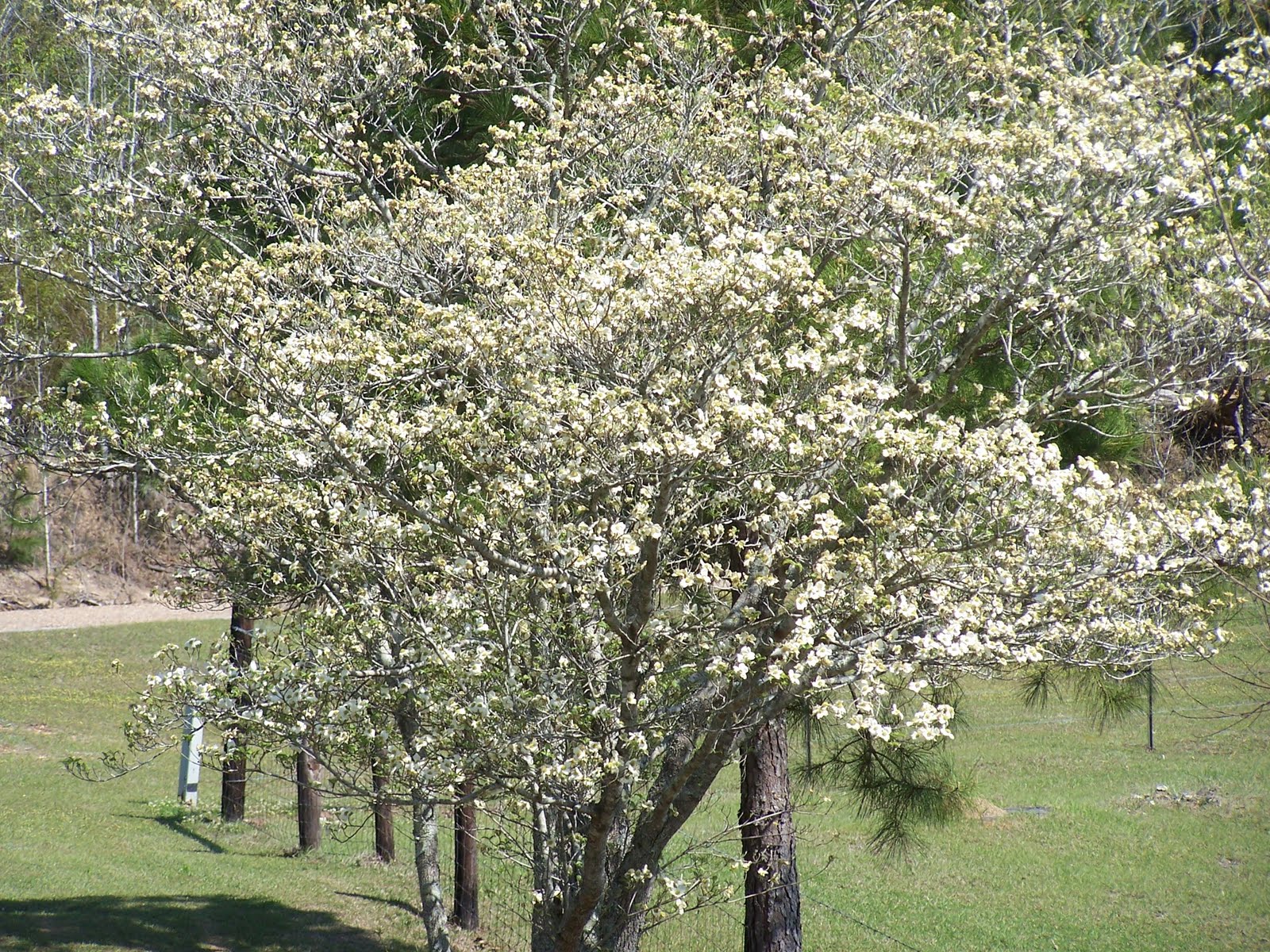
  Dogwood trees shown here are truly fit the Wild bloomer category as they were transplanted from the woods near the here by Mother and Andy many years ago.  There are two trees shown here, but the one farthest away died last year.  I was really sad to see it go as it was always a beautiful bloomer.


These beautiful Fall bloomers are called, locally as Swamp Sunflowers.  They are annuals and regrow each summer or they can be planted from the many seed that are left after they bloom each year.  

There is a bloom at the junction of each leaf and the stem.  They grow to a height of about 7 to 8 feet tall and will have blooms from ground to top.

I will do later posts of pics of Yard Bloomers as they are so beautiful.  There is seldom a time of the warmer seasons that there is nothing blooming around the yards and flower beds, that make Country Living more enjoyable.

Thursday, April 7, 2011

Country Life - Wash Day


Country Life  

Wash Day

Monday was clothes washing day.  Lucy, the black lady that helped raise the four of us children would load up the old wheelbarrow with some lightered (rich pine) to start a fire around the wash pot and some wood to keep the fire going.  Also, she would have all the dirty clothes for the seven of us, scrub board, P & G lye soap, Argo starch, bluing for white clothes and probably a few other things.  She would push the old narrow rimmed steel wheeled wheelbarrow up to the spring across the road from the house.  

She’d begin by building a fire around the old wash pot while running water into a tub from a pipe from the spring.  Then she would begin filling the wash tubs by dipping water out of that tub and pouring it in them and fill the wash pot.  She would put soap into the wash pot and stir it around to get it well dissolved in the water. The clothes that were to be boiled into the wash pot would be stirred occasionally with the “battling stick” a 1” X 3” board about 5 feet long.  (Some folk would put very dirty items on a platform and beat them with the stick to get heavy stains out of them.  Lucy didn’t do that.)  

Items that did not need boiling would be put into the “scrub tub,” add soap and wash them by rubbing them on the wash board a wooden framed board, about 15” X  24” that had a corrugated metal piece to rub the clothes over.  All along the items in the wash pot had to be stirred.  

When the non-boiled clothes were washed, they would be moved over to the rinsing tub, rinsed well, wrung out to get as much rinse water out of them and put into another tub to be taking back to the clothes line in the back yard of the house.  Boiled clothes would follow the scrub and rinse procedure.  

Items that needed starching would be placed in a small tub containing the Argo or flour starch, then wrung out.  

When all the clothes were boiled, washed, rinsed and starched, they would be loaded back into the wheelbarrow along with the soaps, starch, etc. that couldn’t be left out in the weather and taken back to the clothes lines in the back yard.  All the washed items were then hanged on the clothes lines.  If there was a really heavy wash, the overalls and other heavy items would be hanged on the back barbed wire fence.
 
Clothes hanged on the clothes lines would have that good fresh-air aroma to them. 

The next step would to take the things off the lines and prepared for ironing.  All clothes that were starched would have to be sprinkled either by using a small nozzle placed in a Coke bottle or by dipping a hand in a pan of water and shaking water off the hand onto the clothes.  After sprinkling, the clothes were rolled up again until time to be ironed.

Ironing was done by placing three flat irons on the stove or in front of the fireplace (mostly in winter time) and heated.  Lucy would test the proper heat of the irons by wetting her finger and quickly touching the iron with the wet finger.  If it sizzled, the iron was hot enough for pressing the clothes.  The irons would not stay hot very long, thus the old saying to “strike while the iron is hot” was originated.


Monday, April 4, 2011

Country Life = Lonesome Pine


I call this tree  “Lonesome Pine.”  It sits just outside my back yard four miles north of Millry, AL.  My mother used to sit in her kitchen, look out the back door and say, “Just look at that perfect specimen of a Southern Pine tree, just standing there by its Lonesome!”

Therefore, after I inherited the house and barn after her death, I call my place “Lonesome Pine Farm.”  I don’t do much farming in my retirement, but my brother, Joe and I lease out our pastures and the barn.  This keeps cattle on the place that I love to watch from time to time during most any day.  At times, I get out and walk amongst them just to watch them graze in the pastures and kinda look out for the owner’s condition of his cattle.  He runs from 15 to 30 head of cattle and calves on the approximately 70 acres of pasture land.

I used to keep from 12 to 25 head of cattle on the place prior to getting out of the cattle business.  The prices for hay, fertilizer, feed and help was costing me more than I was getting out of them at the stockyards.  Also, that tied us down, especially during the winter feeding time each year. 

Another thing that I have discontinued is trying to have a vegetable garden.  The old garden spot is almost completely in sand bed.  This required quite a bit of work, fertilizer, seed and water, water, water.  We have been having extremely dry summers of late and just not worth the effort trying to grow a few vegetables.  It is much more economical to go to the “you pick” farms and buy what vegetables I need for the freezer.

I try to keep the yards and shrubbery trimmed and pruned to keep it as one of the most beautiful sites in this area.  I enjoy getting out on my riding mower and cut the approximately 2.5 acres every week or so during the growing season.  Last year, the weather was so dry that I didn’t even have to cut it for almost three months.  So my cutting time was cut short during that season. 

So, Country Living has its ups and downs, but you never have a time when there is not anything that needs some attention, yet usually not so much that it gets to be periods of hard work.  I love the peace and quiet, the views down across he pastures, watching the changes of seasons in the Spring and Autumn and all the anticipation of harvesting pecans from some of my 23 trees and the sweet, juicy scuppernongs in late August and early September.  I’m kinda like the Blue Bell Ice Cream people say, “I eat all the scuppernongs I can, then give some away!”

Saturday, April 2, 2011

Living - Down In The Country


Country Life

Now who can’t enjoy living in the country in Southwest Alabama than viewing the rare snow scene pictured above?  

This scene is my home place, Lonesome Pine Farm, including the house where I was born and reared in.  We had a very rare snowstorm on February 10, 2010 that produced about four inches of accumulation.  

The scene is picturesque in itself, but my nephew who is a professional photographer actually took seven shots and using his software “sewed” the seven shots together into one continuing panorama.

This scene was enabled by the hard work of my father, J. Sam Wood.  He retired from the US Army Corps of Engineers in 1965 and returned home to a badly grown up pecan orchard, pastures and an old, rotting barn.

The sad part of this time was the fact that my wife of 52 ½ years, JoAnne, had died the day before from a brain hemorrhage.  We actually had to move her funeral day back one day to avoid folks dealing with a snow storm in the south.  Snow is so rare in the deep south that governmental crews just don’t have the funds to let removal equipment sit for years and not used. 
Over the years, I had said that I would like to retire back to Millry and JoAnne  would say, “I don’t want to go back in those sticks to live.  Those folks are not friendly.  Well, after I retired from Construction Safety Management work in locations all around the country and she retired from Gulf Lumber Company in Mobile, we began spending quite a bit of time at the farm that I named “Lonesome Pine” after my mother died and I inherited the old house and barn with some acreage, we made a couple of improvements to the house by updating the old bath room and removing the old, crumbling double fireplaces and chimney and created a new, large walk-in closet.

Later, we did decide to update the old house with new plumbing, wiring, insulating, all new floors, new central heat and air conditioning, a large room added to the back of the house and a new bathroom.  We lived here for 10 years until JoAnne’s death in February 2010.  Only a week before she died, we were riding down Airport Boulevard in Mobile and she made the statement, “I’m so thankful that we don’t live down here with all this traffic.”  

 She really grew to love Living the Country Life.